
What a Year of OnlyFans Actually Costs Subscribers
If you want to know what a year of OnlyFans really costs, you have to look past the monthly sticker price. A page that shows $5 a month does not cost $60 a year in practice once tips, pay-per-view (PPV) messages, and occasional unlocks are added. This article builds a realistic twelve-month total for a typical subscriber, using public price data and the platform’s own mechanics. The goal is a number you can check against your bank statements, not a guess.
The math is simple, but the timing is not. Subscriptions renew in the month you signed up, promotions pull spending forward, and price changes cancel auto-renew. Each of those events changes the shape of your yearly total. So instead of an average, we track the signals that make one year cost more or less than the same pages would in a different year.
Twelve-month total
Start with the base subscription line. Paid pages typically run from $4.99 to $15, with an average of $5 to $10. The platform-wide paid range is $4.99 minimum to $49.99 maximum, and there is no base price below $4.99. Only promotional first months can dip below that floor. Free pages are simply pages where the price is set to $0, and they earn through PPV messages and tips instead.
To reach an honest annual figure, separate three spending streams: recurring subscriptions, one-off PPV unlocks, and tips. Treat each stream as its own column, then add them. If you merge them too early, a single heavy month will distort the entire year and hide the pages that are actually expensive.
| Signal | Clear good example | Clear poor example |
|---|---|---|
| Base price level | Most pages sit at $5-$10 a month | Several pages at $15 or more per month |
| Free versus paid mix | Free pages used only when you want a specific unlock | Free pages producing regular PPV spending every week |
| Promotional timing | Discounts used to start a page you already planned to keep | Discounts used to start pages you drop after one month |
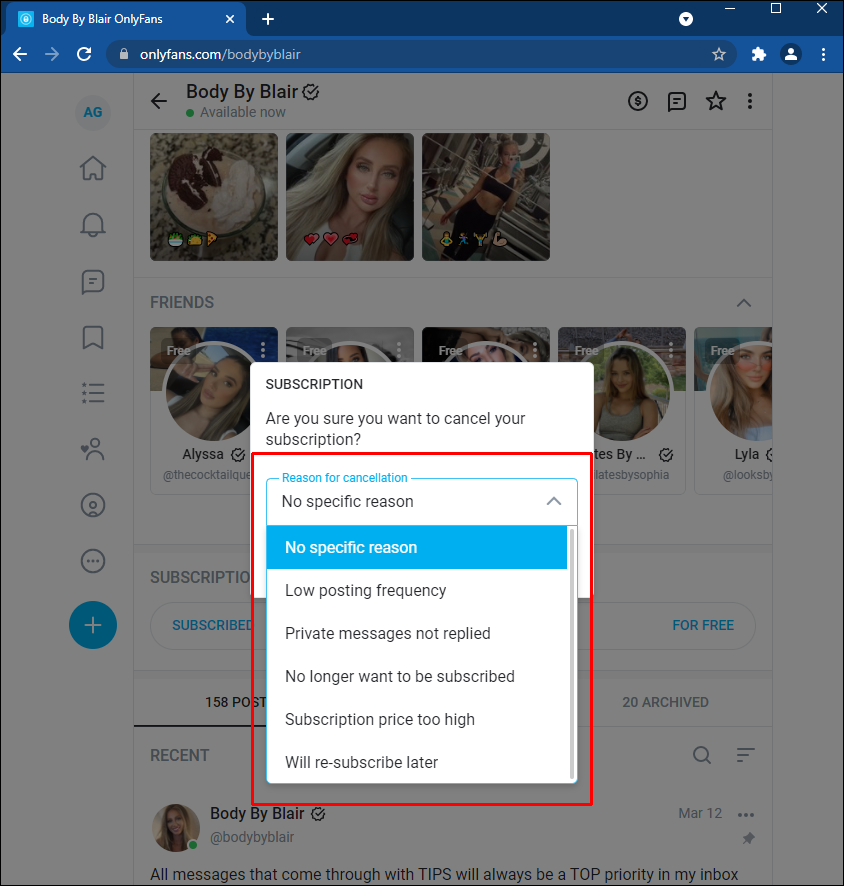
| Auto-renew status | Renewals left on only for pages you open monthly | Renewals left on for pages you stopped reading |
| Tips frequency | Occasional tips tied to a specific request | Routine tips sent without reviewing the total |
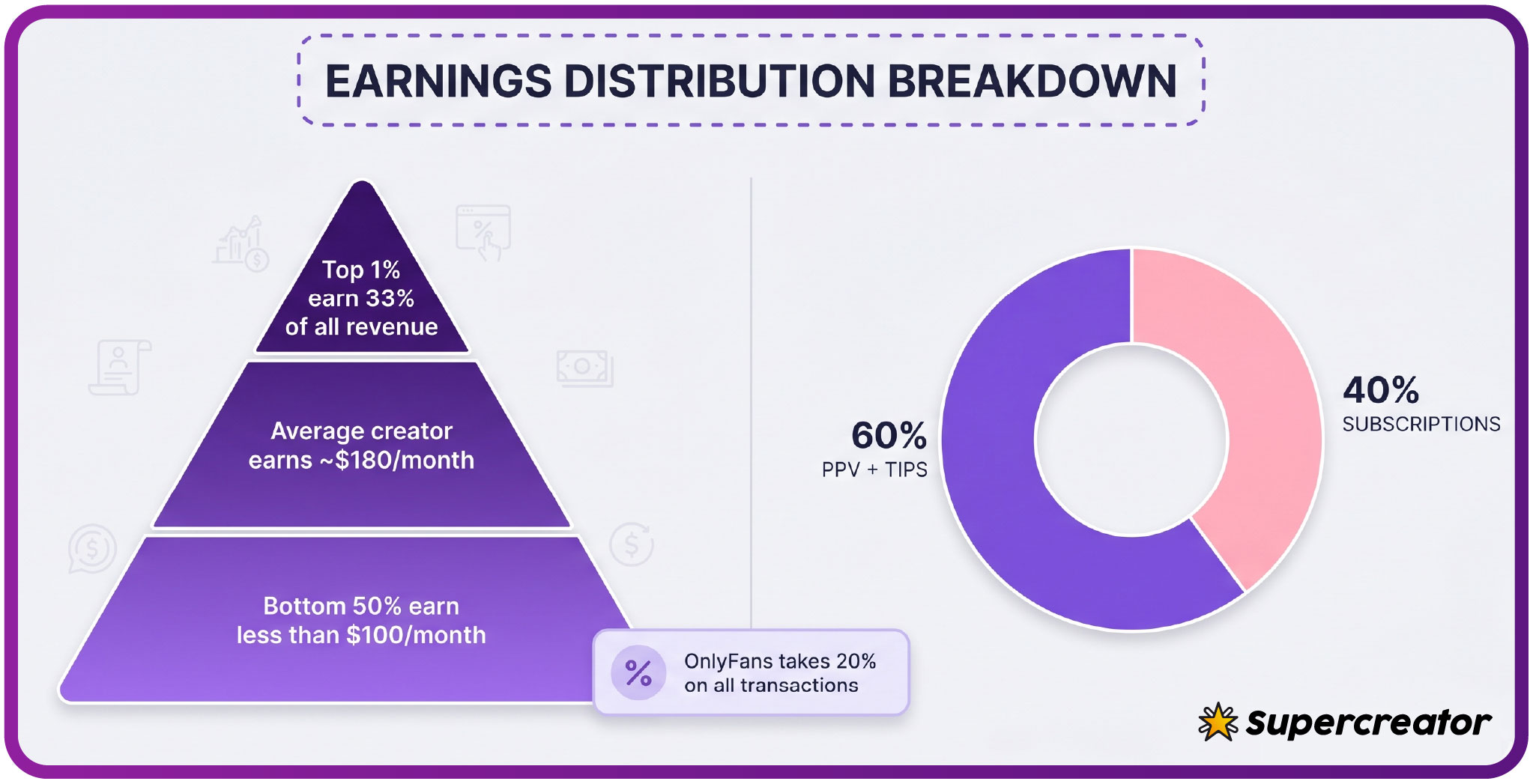
Take a ten-page example. If eight pages average $8 and two pages average $12, the base line is $88 a month, or $1,056 over twelve months. That is already a serious number before any PPV or tips. The platform takes a 20% fee on everything — subscriptions, tips, and PPV — and the creator keeps 80%. Your cost does not change based on that split, but it does explain why creators push extras.
Monthly shape
Not every month costs the same. The differences come from when you subscribe, when promotions end, and when you send extras. A page joined in January renews in January, but a page joined in June renews in June. If you join several pages in the same month, that month becomes heavy every year.
Promotions shift the timing more than the total. A discounted first month moves a charge forward, but the renewal returns to the normal price. That means the month after a promotion usually costs more than the promotion month itself.
- Months with several renewals on the same date, which concentrate charges.
- Months after a promotional first month, when the price returns to normal.
- Months when a creator raises the subscription price, which stops auto-renew.
- Months when you add PPV unlocks for pages you already pay for.
- Months when tips are spread across many pages instead of one.
- Months when you join a new page and stack it on top of existing renewals.
Practical tip: before your next renewal date, open your subscription list and note which pages you actually used in the last 30 days. Pages you did not open are the first candidates to drop, and removing them changes your annual total immediately rather than at the end of the year.
There is also the price-change rule. When a creator raises the subscription price, auto-renew stops, and existing access lasts until the current paid period ends. That gives you a natural review point. You can decide to pay the new price, keep the page until the period ends, or leave entirely.
Forecast table
If you keep the same pages and the same habits, the next year looks a lot like the last one. The table below projects a twelve-month total across four spending profiles. Each row uses the same three streams: base subscriptions, PPV unlocks, and tips.
| Profile | Pages held | Base per month | PPV per month | Tips per month | Yearly total |
|---|---|---|---|---|---|
| Light | 3 | $18 | $6 | $4 | $336 |
| Steady | 6 | $44 | $14 | $10 | $816 |
| Broad | 10 | $88 | $22 | $18 | $1,536 |
| Heavy | 16 | $150 | $40 | $35 | $2,700 |
These are projections, not statements about any named creator or account. They are built from the public price bands: pages typically run $4.99 to $15, average $5 to $10, and never start below $4.99 except during a promotional first month. Change any column and the yearly total moves with it.
The forecast is useful because it turns an abstract monthly habit into a figure you can compare against other annual spending. A steady profile at $816 a year is not the same decision as a broad profile at $1,536, even if both feel like the same small monthly charge. BestOnlyFans compares public profile prices, promotions, activity, and media counts so subscribers can see those differences before they commit.

Extras share
PPV and tips are the part of the total that most subscribers underestimate. They arrive as individual messages, not as a single bill, so they are easy to approve one at a time and hard to see as a yearly number. A practical starting point is best onlyfans budget hub, which lists pages by the signals above.
- PPV unlocks attached to a page you already pay for, adding a second charge on top of the base price.
- PPV unlocks on free pages, where the page costs nothing but the messages carry the price.
- Tips sent to request specific content, which can repeat monthly if the request repeats.
- Tips sent during special events or limited windows that end quickly.
- Small impulse unlocks that add up across many pages rather than one.
On a broad profile from the forecast table, extras add $40 a month, which becomes $480 over the year. That is nearly a third of the base line. A ranking service such as BestOnlyFans is useful here because it lists activity and media counts alongside price, letting you judge whether a page’s extras are likely to keep appearing.
Drop candidates
Once you have a twelve-month total, the next step is to find pages that did not earn their place in it. Use activity, not intention, as the test. A page you plan to read but never open is a drop candidate.
- Pages you did not open in the last 30 days but still renew.
- Pages where you only used the free feed after paying for a subscription.
- Pages whose PPV messages you consistently ignore.
- Pages you kept after a price increase but never checked the new price against use.
- Pages you joined during a promotion and never returned to after the discount ended.
Removing three pages at $8 a month cuts $288 from the annual total, before any change to PPV or tips. The savings are not from a single large decision but from ending several small recurring charges.
Warning: when a creator raises the subscription price, auto-renew stops, and access lasts only until the current paid period ends. If you want to keep the page at the new price, you have to resubscribe manually. If you do nothing, the page simply ends at the close of the paid period, which is often the cleanest exit point.
Renewal math
A rolling month-to-month habit and a fixed one-year plan are not the same thing. The rolling habit renews every thirty days on multiple dates, which spreads charges but also keeps payments running when you are not using the pages.
That is the gap a comparison service such as BestOnlyFans is built to fill, by placing public profile prices, promotions, activity, and media counts side by side.
- Avoid paying for pages you stopped opening, because the charge keeps running silently.
- Avoid keeping auto-renew on for pages you only wanted for one month.
- Avoid treating promotions as a reason to add a page you did not plan to keep.
- Avoid sending recurring tips without checking the yearly total first.
- Avoid ignoring the price-change notice, because renewals stop and access expires.
Compare the two patterns directly. Rolling month-to-month on ten pages at $88 a month is $1,056 over twelve months if nothing changes. A quarterly review that drops two unused pages in month three cuts roughly $150 to $200 from that same year, depending on when the drop happens.
A phishing link usually copies a familiar billing screen to capture card details.
Annual review loop
The final step is a simple four-checkpoint loop that keeps the next year predictable.
- Checkpoint one: list every page, its current price, and its renewal date.
- Checkpoint two: mark pages you did not open in the last 30 days.
- Checkpoint three: add up PPV and tips for the period and compare them to the base line.
- Checkpoint four: drop or pause the pages that fail the first two checks, then recalculate the yearly total.
Repeat the loop four times a year.
The platform fee stays fixed at 20% on subscriptions, tips, and PPV, with the creator keeping 80%, but that split does not change your cost.
FAQ
What is the lowest possible monthly subscription?
The minimum base price is $4.99, and no base price sits below that. Only a promotional first month may dip below $4.99.
Do free pages cost anything at all?
A free page is a page where the price is set to $0.
What happens when a creator raises the price?
Auto-renew stops for that page, and your existing access lasts until the current paid period ends.
Why do ranking sites exist for this platform?
There is no built-in discovery feed or directory, so subscribers rely on outside sources.
The yearly total is the most useful number because it matches how you actually pay across twelve months.